
bloom anyway
on how much I really love my baby sister (& her EP)

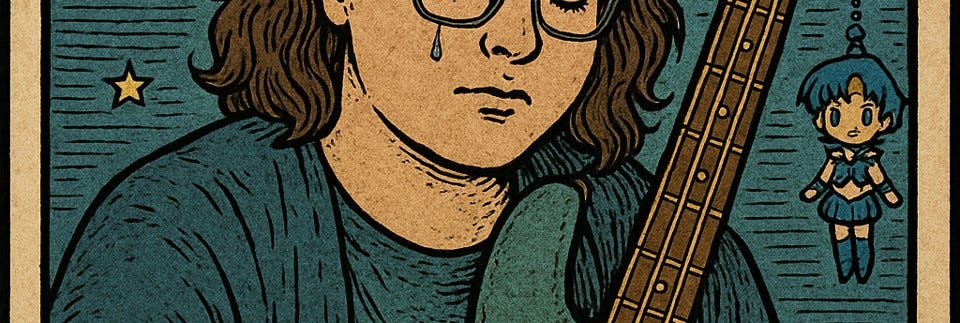
There was always music in our house; there’s always music in every house. But it was a little more prevalent in our Bergenfield two-story plus basement, for in that basement, our dad would apply his musical gifts to the recording of multitrack tapes. Moreover, the art of the album was inescapable — those invitations to worlds of information and emotion whose covers and tracklists we rarely got past as curious kiddos. And our car was an alt-rock jukebox: Lucinda Williams, Robyn Hitchcock, They Might Be Giants, Ween and Daniel Johnston songs Daddy-O would puckishly unsettle us with. Radio pop and hip-hop found their way in too. The whole thing was a kind of wonderland.
It’s not only impossible to overstate but to explain the influence all this music had on my little sister Chicory and I. (Lest you mistake my parents for daring eccentrics, her name is of her own choosing.) We were always linked in ways we still share, my sis the great gift of a guide and best friend and foil and occasional collaborator not everyone gets in a sibling. We perceive this life through a crooked lens, but don’t have to strain to mutually translate our experiences. We are, it can by now be safely said, smart and strange, kindhearted and complicated, imaginative and — to vastly different degrees — discerning. We live on a gender line, yet at our most alienated, we feel extraterrestrial.
But hard as the world can be on us (our paths through it at times miles apart), Chic & I really are in love with it. Even mere colors and numbers set our fancies aflame and our brains alight. Childhood in the ‘90s was quite the sensory overwhelm, and as I say all the time, there was a false sense of shelter, one that in our privilege wasn’t false at all. Action figures and video games and full-length animated features and blue food and the trippy wilds of contemporary kids’ television: all of this dazzled us, became things we wanted to not just untangle or dive into but evoke. We all learn by imitation on a certain level, don’t we? And at what point does the imitation become the real thing?
My dad might have only have seen the margins of a professional career, though as I’ll explore in an upcoming post, there is actual vinyl proof of his existence as a real, band-studio musician, not just stuff he curated himself and slipped under doormats. But as befits the home-recording age he matured in, his voice as a writer really flowered with those basement tapes — the first two of which were released by Swales’ drummer Eric Harris’ “homemade cassettes catalog” (per Bar/None) Sonic Delights. At times, they’re sonically crude, belying the clear talent on display, while Dad was in good company as a somewhat unsure singer. But our father* is a brilliant musician, and a legit one, too.
Gifted a 4-track at thirteen (in 2000), upgraded to a digital 8-track after only one year (as a reward for my frightening prolificacy), I am a more complicated case. I’ve written countless times on this ‘stack about my band the Pozniaks, me and my late best friend Tim Brauer — the closest I’ll come besides Tim’s sister Megan to another true sibling. But the “band” designation is debatable. I guess, multitracking in my bedroom around my machine, we were like a green, teen They Might Be Giants, or another precocious duo of fools-around. But distribution over a five year scare-quotes career was limited not even to how many CD-Rs we jazzed up, but how many of our pals accepted them.
Bizarrely antisocial at times, and terrified of rejection, Tim and I never let ourselves explore the tactics of a rhythm section or professional recording technology after the band’s abortive initial quartet spell. When he and I split, I kept on making multitrack recordings, intermittently and often listlessly, through the four years it took for Chic, at age 23, to try out music herself. She’d had her territory — Chic is a championship-thoughtful video game connoisseur — and I’m not sure if she was bashful to tread into an arena my dad and I had already claimed as our own, or just ceding it to us. In any case, a girl broke her heart, and Chic astutely set her sights on the blues as an outlet.
My sis’ first tentative step into musicianhood was the harmonica, and she’s still quite good at it, on a spectrum from party trick (and how) to literal snake charmer. But once she found fluency in the diagram and deep melodic reservoir of the bass, she was off to the races, on tracks I’d seen her hanging around before. Chicory’s specialty is the loop, and she favors resonant, ambient improvisations based on two-note harmonic figures, though she’s also plenty dexterous. But like her brother — who’da thunk? — Chicory was not just attracted to exuberant melody but prefab-as-soulful, just like the Pet Shop Boys, or the J-Pop to which some of the artistic diversions she favored were gateways.
As she’s maneuvered the cruel world, Chicory’s never settled for just one niche. She is the dilettante-as-wizard — lock-picker and sharp-shooter and chess mistress and the best tarot reader in Texas, an egregiously incomplete list. Her très-analytical mind was surely strengthened by the games I threw down like Verrocchio’s paintbrushes when I realized she was swiftly excelling me, though I certainly don’t regret the piano lessons where I redirected that energy (thanks Mrs. Miller and the eminent Margaret Ingram). But her aptitude for taking something apart and then constructing it anew, or just the second step, inevitably found a place in the mathematics of music and recordmaking.
That said, we’ve had numerous discussions about art and audience, and our divergence is characteristic. Our rough dichotomy is libertine and stoic, or even hare and tortoise, and Chic’s optimism is of a Zenner school than my wild-eyed flashes of indulged hope. We’ve both shackled ourselves to the god of perfectionism, blinded by some luminous specter of an endgame we assume exceeds our grasp. In a way, Chicory is less inclined to let the size of her ambitions dull her impulses. But she has a bit of a sand-mandalas idea of art’s function, or possibly (though I hope not) her art’s function. Chicory loves to create, does it less anxiously than I. But she does not love to chase attention for it.
Where this frustrates me, though somewhere in her mentality is that question of when the art attains “legitimacy”, concerns the terrific EP Chic has had up online since ‘22, under the name xAnnieBonesx (Annie St. Bell is her musical guise). In the wake of the Pozniaks, Chicory watched me conceive a glam-punk project called Jackie Mayhem & the Reasons Why Not, only to flame out under the weight of the visions. Though still the tortoise between us, as she traverses a path I’m two years ahead on, she comes to realize my pitfalls are not always as evitable as a crafty girl like her might manage. She too got lost in the haze of musical daydreams, and she’s the one with a pilot’s instinct.
But in late 2022, she charted a course into the epiphany that Just Doing It often yields results as well-constructed and inspired as whatever you told yourself you couldn’t put together yet. Embracing the small scale she’s always spun gold from, she limited it to EP size, six tracks (including two instrumentals, a choice I might have discouraged if asked — my sister’s way with words is world-class). Like Stephin Merritt, an absolute titan of home recording — and also, me — my sister likes working with schemas. It’s not hard to see why ROYGB[I]V was her move: it’s gay, it’s universal, it’s colorful, man! The title’s sword may be more than double-edged — either way, Chic dances across it.
Spectrum took not quite as many weeks as number of songs to assemble. Whereas I’m a stick-in-the-mud luddite, a can’t-be-bothered tech type (i.e., not a tech type), Chicory always finds joy in getting a feel for new programs. The one she was into at the time was Korg Gadget; she also used an Arturia Microlab controller, and a Zoom V3 vocal processor plus Shure SM58 mic for autotuning. (What’s good enough for Charli, etc.; Chic & I have never won note-hitting contests, though she finds sweeter things in the high end of her similar voice.) The sound is homegrown but not really lo-fi. It’s bright and shiny, on top of impressively contrapuntal. Yet there is a slightly dysgraphic aura.
When I say here that my sister is “cute”, what I will rush to clarify I mean is that there has always been a sort of “wisest child” vibe to Chic. She is modest, sweet, whimsical; she has a touch of babyface she’ll never lose and an affect to match. But her mind is all razors and gemstone contours. Where my solo music tends scruffy and manic, Chicory is always deliberate — you surely guessed by now that she is the more discerning one. While I know Spectrum needn’t stand as the only available swatch of the breadth of her vision or talent (and there’s more, including this track we proudly concocted together), I think it lives neatly up to its title, in giving you a reasonably comprehensive glimpse.
When Chicory first played “Yandere” for me, I couldn’t believe how good a pop record it was — not just a pop song, a pop record. (After a moment of mulling how to explain ‘yandere’ to those not in the know — I wasn’t — I’ve decided to just let you Google it.) The intensity of the subject isn’t exactly Chicory’s favorite flavor; all of her lyrics play with character, none more than this fusion of poignant longing and comic horror. The lilting “the sweet disasters of a girl in love…” intro offers typical melodic rewards. Like John Darnielle, Chicory likes simple chord progressions and forthright melodies, from which more complex lyrical ideas launch. But she’s gleaned a thing or two about build and craft and dynamics. The “you make my heart go” followed by the thumping kick is one of those ingenious little tricks that could sell you on pop music as art’s peak form.
I do stage acting; Chicory’s never touched it. Yet you hear in the subtle, wicked twists of the vocal a born performer’s savvy. The elements around it are spare and insistent: fat liquid pulse, an almost Psycho-esque soft screeching discord. I enjoy how Chicory manages to sing off the beat just enough as it persists — all intention and assurance and zero pretense to professionalism, which roughs up the programming’s precision. But her vocals are as slick and pointed as a switchblade you didn’t see coming. There’s a ghostly “ooh” hook, fantastic, then a new section (“ohh my love…”) that beats it even if some of it could stand some EQ. If treated as a demo, someone with scads of money could maybe borrow and bolster what’s here. But this is too on point for outsider art.
An endearing interlude follows: “Music for Space Whales”, the title a rather arbitrary example of Chic’s gently absurd humor (Spectrum’s subtitle, “Songs for Gay Robots”, is less obviously a joke). I figure my sis had fewer ideas for how to embody “orange” than the whole red = blood thing, but for pacing and soundscaping, “Whales” is an alluring beast. There’s a vague “tropical” vibe that becomes explicit when the steel drum patch kicks in. Once again, what you’re hearing is the kind of pop composer who always has more strong little hooks on hand than songs to fit them into. She takes a humble solo, its stray blue note one of Spectrum’s few. We learned from Dad, directly or by osmosis, how much pop arrangement is building up and paring down at just the right moment; the principle applies across Spectrum, but its instrumentals are where you notice most.
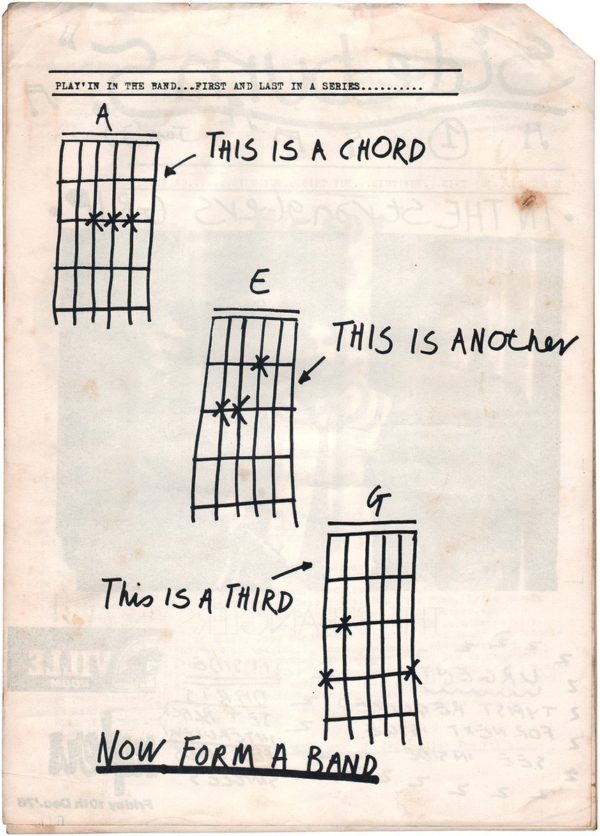
Phase Yellow, meanwhile, is anything but yellow — by which I mean chicken. As her project started finding its legs, Chicory would sometimes text to brain-pick. “Explain punk to me,” she requested one day, evidently seeking to diversify the stylistic profile, so I sent her Tony Moon’s fanzine cartoon — “this is a chord, this is another…” Out of this soared the three-chord Molotov cocktail “Anarchy Aunt”. And while from musical DNA to sentiment it’s irrefutably punk, it’s also the kind of thing we really need near the top of the pops. I’ll treat you now to the first two of three ace verses, and let my sis, an LGBTQIA+ icon always on the right side of the good fight, complete the trifecta for you. Spare and fleet, rough yet poised, this anthem is, for me, the sextet’s crown jewel.
Go out on a Sunday in a new chiffon top
Drink a mimosa, throw a brick at a cop
Never been much for loving, but if it’s family you want
Honey, I’m not your Pride Mom, I’m your Anarchy Aunt
[blissfully dumb solo]
Smash a bottle of whiskey, chase the shadows away
Take you out for ice cream, burn down a Chick-fil-A
When your guardian angel only gets you so far
Honey, I’ll be a monster, so you can be who you are
I take great pleasure in hearing Chic play around at the heavenward end of her range, the AutoTune chopping dizzy melisma into glinting little pearls. There’s something a bit Morrissey about this cut for me, in its blithe viciousness and frolic-in-a-frock flair. But despite the end of that second stanza, there’s nothing nearly as monstrous about Chic’s message — this is just that liberating, increasingly fashionable violence-is-the-answer, doled out in doses and as tongue-in-cheek as ya like, Officer. Chic has a killer deadpan, competitive even, but like the young Moz, it barely restrains a reckless glee. There’s no Johnny Marr, but Little Missdemeanor makes a meal of meat and potatoes.
The second half is the night half, the difficult half perhaps. Here, Annie hangs up the whimsy, and pairs a pair of so-lovely-they’re-stately melodies with a pair of so-stately-they’re-lovely lyrics. Straining a bit into her low end, “Bloom Anyway” sounds a lot to me like my beloved Magnetic Fields, if Stephin shed his mordancy for three minutes; that Chic never really got into them strikes me as a matter of her never getting around to them. No insincerity stains these lyrics, whose poetry covers terrain familiar to me from almost a lifetime of knowing my sister — the burden of the unlikely, vulnerable and wounded to proclaim their value, and so loud the whole world can’t help but hear.
When seeds are sewn beneath the clay
Beneath the road that hadn’t been there yesterday
When all the storms have gone away
We disobey, and bloom anyway
Whatever we were lucky enough not to suffer, there’s a great drama in us two sprouts having made it this far into adulthood with identity and sanity intact. Sensitives born to sensitives, our weather hits harder and changes with less warning. We wake up and go to bed without stable security our being alive matters at all, offset by a faint notion that what we have to say might resound uniquely enough to be worth the air we put it out into. I know my sister has faced an even more uphill battle, clearing mountains of doubt. So when I’m at my lowest, she’s the North star I look to. Because if she speaks for the both of us, or for all the misfits she loves most dearly, she will assert our value without missing a beat. She knows what’s right, and what’s right is to claim your seat.
Casio-grade patches symphonically converge. A filter leaves the dour yet determined vocal both dewy and flinty; it mysteriously flatters the lyric. Then suddenly we’re in a storm on the sea, and the AutoTune is laid down for a show of exquisite fragility. It’s a necessary choice: Phase Blue needs its blue notes, which AutoTune is built to zap. Up in the least sturdy heights of her voice — shades of Wayne Coyne all awestruck in the prettiest passages of The Soft Bulletin — Chic gets startlingly impassioned on “Fall On Me Slow”. The trick is how close to breaking she sounds when she insists, “it’s kinder than you know”. This is the future psychology major who’d stay up late on AIM before she was 17, offering medicinal consolation to anyone who deigned to spill guts. Chic’s outlook is radically positive, a faith I need this music to realize has always been there.
Grand finale “Nebecula Minor”, Phase Purple, is appropriately rich and dark, and the atmosphere could fairly be called celestial. With its unviolated repetition of a IV-V-iv — tried and true, to be sure, but possible to exhaust — I always found this one a little wanting, given its company. But Chic saw it as the magnum opus, and as I’m sure I’ve made clear, I put just a little too much stock in the way she sees things to rule it out. Yet another thing she and I always shared was a sense of dramatic scope. Together, as kids, we invented elaborate sagas with anthropomorphized toys. And while that’s not at all uncommon, I always wondered, when the movie reached its eye-welling climax, or when the elaborate saga we’d spent our afternoon on echoed it, if how palpably we were sharing those big feelings was evidence of some form of telepathy of the heart.
I have felt that synergy most acutely and profoundly whenever Chic & I have shared a musical experience, be it jam session or listening session. I have nearly run out of all my little words, effusing weekly on JACKALS!, for how music transcends: its defiance of linguistic constraints, its unifying power. When the musician within Chicory finally saw fit to emerge, it was like a mirror of everything I’d been after, one which reflected what could never have occurred to me without her reframing it. My sister and I share a language as songwriters, along with the doubt we’ll ever really earn the mantle. But we write songs; we bloom anyway. And while we’ll continue to hone and evolve as we take new artistic chances, both alone and in tandem, I insist that the flowers we’ve already tended merit just as much sunlight — especially Spectrum, with its vivid iridescence.
*who art in the garage (what would this piece be without an asterisk & an inside joke?)