
string driven thing
a chat with Bob Stanley about American baroque-pop

My few but precious readers have no doubt by now learned some of my particular pop-musical preferences. A strong sense of melody. Verbal intelligence. Crafty hooks. And, perhaps above all, a degree of idiosyncrasy. A big beat doesn’t always win my ass over without also appealing somehow to my mind — regretful, but true. I nevertheless love a great deal of music I don’t naturally like, and I admire and aspire to the omnivorous objectivity many of my favorite fellow travelers have made their stock in trade. But as I explored at length in the “Eclecticity” piece, a sound that clearly or even inexplicably reflects unmistakable personal taste is hardly to be distrusted. This extends to specific instruments — and perhaps no musical sound lights up my soul with as much alacrity as the string quartet. The cello, in particular, feels as if it peerlessly bridges roughness and grace. In pop as we’ve come to know it, one typically begs balancing by the other.
“A hard string,” I often qualify, as if that’s a common way to put it, so as to distinguish from the large orchestra, which compared to the innate rhythm and thrillingly audible counterpoint of your chamber ensembles becomes an overbearing, saccharine mush at worst. I want the natural percussion of the bow on the string, a little force around the edges of a viola/violin/cello/bass’s deep and resonant yearn. My brief classical phase as a grade schooler was pure pretension, but I learned to crave that sound. And though I code quiet, bookish, fey, I’ve always been a messy rebel with a rock ‘n’ roll heart. Thus, pop music enriched by a dose of hard strings is something like heaven on earth for me — and for a brief period, inspired directly by the Beatles, a slew of wonderful records bearing this signature proliferated with the doomed immeasurability of doo-wop 45s.
It wasn’t just string quartets, of course, though “Yesterday” and “Eleanor Rigby” (yes, this stylistic phenomenon might well have been All Paul) guaranteed their occasional prominence in great pop all the way down to this century. Around 1964 and 1965, the harpsichord, that ungainly pre-piano sometimes hauled out for Mitch Miller conceits, began to creep back into British music in a way that specifically evoked checkerboard-tiled parlors from bygone centuries. What this all began to amount to was a backward-looking yet entirely novel sound eventually known as baroque-pop, or -rock for those who dug the punny syllabic repetition. And while in a sense, this style is definitively “rock” — a cerebral, aspirational outgrowth of rock ‘n’ roll — it boasts a delicacy, or even a fragility, that makes the listening exceptionally easy for an r‘n’r subgenre. The preferred pejorative for this style was “genteel”, most often by skeptical Americans.
European audiences, of course, were less resistant — this was their invention, and it drew from something in their DNA. The foremost passionate chronicler of this music is Bob Stanley, heroic pop historian and one third of the late, great St. Etienne, itself always something of a history trip as well as a progressive electropop (for tragic lack of a better term) group. Concurrently with a definitive Guardian article, Stanley — who these days is also Ace Records’ acest compiler — put together the magnificent Tea and Symphony compilation for Castle Music in 2007. This CD was the most coherent and convincing case for baroque-pop yet made, though it left out many of the style’s more celebrated practitioners (the Zombies, Honeybus) in favor of wondrous one-shots by disappearing acts: Julian Brooks’ “Justine”, Jon Plum’s “Alice”. (Not all baroque-pop songs were about girls, but about 95% were wispy lads pining through rainy panes.)
I personally prefer Ace’s 2020 update, which Stanley himself says suffered a handful of regrettable licensing concessions, a compilation artist’s chief peril. “If I could’ve done a straight reissue, I would’ve done. But I did want to include the Honeybus or [Colin Blunstone’s cover of Denny Laine’s] ‘Say You Don’t Mind’, just in case people didn’t know what I was talking about with the first one. It seemed churlish to ignore them, because they’re such good examples. They were hits!” Still, as Stanley concedes, few today are aware of the latter point. For this American thirtysomething, the rapturous Blunstone single (which only features a string quartet, and was produced by fellow ex-Zombies), or a song like Clifford T. Ward’s “Coathanger” (one of the last releases on John Peel’s short-lived Dandelion label, and possibly the only one Peel hated) were soul-stirring revelations I needed Stanley’s CD to discover, not to mention to link.
See, as with most pop, the rules of baroque-pop weren’t strict. The line to authentic 17th and 18th century baroque music is tenuous. Obviously, the strings, woodwinds and harpsichords were retrieved more or less directly from the style, and between the contrapuntal arrangements and a frequent air of prim stiffness, so was its essence. But my favorite detail from my very casual research (not that I’m unacquainted with one J. Sebastian Bach) is that the Portuguese word from which the term derives translates to “misshapen pearl”. And frankly, I can’t think of a better way to describe these records, whose charm is both in their secondhand finery and their natural roughness. Baroque-pop 45s are often just a more ornate bubblegum, and while they’re hardly garage-born, there’s often a scruffy honesty, or less-than-pristine sound, which makes for a winning juxtaposition with the frills and gilded edges that hallmark examples of the subgenre.
As Stanley knows well, the best ways to define baroque-pop are imagistic descriptors. His Guardian article dreams up “a pot of tea [and] a ginger cat on the windowsill”, and its choicest, most evocative phrase, “summer-into-autumn melancholy”, resurfaces on the back of a marvelous new Stanley compilation Ace put out earlier this year, simply entitled American Baroque. For here is the twist in the story — though the very sound of a string quartet brings Europe straight to mind, American pop musicians were in fact the first to fool around with such grandiloquent trimmings. Think Brian Wilson and Phil Spector and Burt Bacharach* bending entire orchestras to the art-rock whims in their heads, or the first “pop with strings” records that weren’t by crooners, like the Skyliners’ “Since I Don’t Have You” or the Drifters’ “There Goes My Baby”. And the archetypal baroque-pop act was from the wrong side of the Atlantic: the Left Banke.
In the new CD’s liner notes, Stanley identifies the Zombies as the true originators — and indeed, their keyboard player may have been the first in rock to wear his classical influence on his sleeve. “I remember Rod Argent talking in an interview about singing a hymn at school and saying, ‘well that’s got quite a bluesy feel to it’,” Stanley tells me. The band’s seminal debut single “She’s Not There” was said to be a direct influence on Michael Brown, the architect of the Left Banke, and as such, baroque-pop itself. Yet it doesn’t feature strings, and while Argent’s Hohner Pianet work is virtuosic to be sure, the jazz influence is more pronounced. So yet again we’re forced to blame the Beatles for starting something — George Martin’s infamously arch solo on “In My Life”, sped up to sound harpsichord-like, was a prescient drizzle of notes (more so than, say, “Play With Fire”), but the stream’s true sources were, yes, “Yesterday” and “Eleanor Rigby”.
“I think Paul McCartney almost certainly got it from living with the Ashers, and Peter Asher playing classical music around the house, which he’d never grown up with. And the Zombies all went to a public school and had a proper musical education; obviously that was an inspiration for their songwriting. You won’t get any of that with the Kinks or the Pretty Things.” The Beatles begat nearly all their peers, Argent & co. included, and by the middle ‘60s, a band that had kicked off as a visionary reconstitution of US influences now had the States in the palms of their eight hands. Perhaps Argent had been attracted to a whiff of blues in the cathedral, but the new sounds on the road to Pepperland increasingly rejected blues. The Left Banke’s Brown was to my ears deeply distinctive rather than derivative, but no pop writer was better at evoking the antique music even his violinist father Harry Lookofsky had given up for jazz decades before.
The popwise know the tale — those rococo cultural shifts the Beatles inspired were in full flower in 1967, and had gone bust by 1968. And while a lot of American art-pop in 1967 was pure imitation, à la Carnaby street couture, Stanley shrewdly delineates the distinction between US and UK acts in the CD’s liner notes. He notes that “baroque-pop’s American practitioners often came from a folk background” — which, without getting into the stolen land element (or blues!), is as close as America comes to a native musical tradition. He notes their “affinity for acoustic instrumentation” as well as “a deeply wooded feel”, which instantly conjures images of a New World unmolested by pavement and urban cacophony. “I think it’s that the American studios have a sort of spaciousness you don’t get on the British records, which sound much more compact, like ‘Jennifer Juniper’ by Donovan,” he opines. “And it tends to be more producer-led.
“The American sound is really based around Lenny Waronker, Van Dyke Parks… those people at Warner Bros. really had something special going, and felt like they were as a group pushing American music forward. Things like the Harpers’ Bizarre albums are so strange, listening to them now. It must’ve made sense at the time, but [nowadays], they’re just extraordinary.” I note Randy Newman as a member of that collective, and how his first album is smothered in strings — ornate in a way that’s less determinedly American than much of his later music, though the film-soundtrack scion never gave up orchestras except once. “[That first album is] the only one I like,” confesses Stanley. “it took me a long time to come to that, but I’m going to get rid of all his other records because I just don’t like the sound of them. But the first one is wonderful. And why he chooses to do all the later albums with this sort of bar band I don’t really understand.”
Of course, this was in part because of that short shelf-life for the style’s primacy. Sure, “Walk Away Renee” may not have charted in the UK until the Four Tops’ version, but naturally, the Brits were less abashed about strings and things than Americans. Two late-addition coups on American Baroque are Nico’s “The Fairest of the Seasons” — one of the most definitively “autumnal” recordings in history, even if it probably refers to spring — and “Different Drum”, Linda Ronstadt and the Stone Poneys’ wistful original version of the Mike Nesmith chestnut. Both recordings caused their artists immense distress, each forcefully rejecting the orchestral touches. Nico would soon rope John Cale into producing antithetically ugly albums, though Cale himself wasn’t exactly a baroque-pop opponent, while Ronstadt would become a cornerstone of a ‘70s studio music whose slick meticulousness would be spearheaded, ironically, by Peter Asher.
As I talk to Stanley it becomes clear that we share some tastes here — we’re not Tim Hardin sobbing outside of a locked studio where his stark acoustic tracks are getting mercilessly overdubbed, we’re Phil Ochs rushing headlong into extravagant big ideas. Stanley himself cites Ochs’ post-Pepper Pleasures of the Harbor as one of the definitive ‘American baroque’ LPs, along with The Left Banke Too and Judy Collins’ Wildflowers (“I’d always look for things on Elektra, because things on Elektra from 1966 to maybe ‘70 would quite often be baroque-folk — Diane Hildebrand or Steve Noonan or these people who made one record and disappeared”). Forgetting that he gripes about it in the comp’s notes, I mention Pleasures as a sign of its times, and set him off on Robert Christgau’s pan (“cluttered with gaudy musical settings that inspire nostalgia for the three-chord strum”, or “[Ochs’] guitar playing would not suffer much if his right hand were webbed”, a line Phil jotted in his notebook under the heading “the critics rave”).
Playing devil’s advocate for a moment, I note that Christgau has always been fiercely skeptical of pretentions (excepting some of his own, perhaps), and that the very sound of a string quartet signifies for certain meat-and-potatoes rockers a kind of pretension or even elitism, a stultifying loftiness, an upturned nose — or simply, as Christgau had it, “decadence”. “That’s really interesting,” Stanley concedes. “I hadn’t thought of that, and I think you’re absolutely right.” He continues, “the reason [baroque-pop] would’ve absolutely hit the rocks in 1968 is because of the politics of 1968 — nobody wanted to be seen as pretentious, to use ornamentation [as with Pepper]. Everything gets stripped back, and it becomes about how ‘real’ they are. The Band are responsible — I hate the Band. Well, I don’t hate them, but I hate what they did to music in 1968!” I love them, but agree with his take on the Ochs pan: “Really? Can you not get anything from this?”
“I don’t know, I just felt like music was — as we can hear on this compilation, or with Magical Mystery Tour over the White Album — going in a really interesting direction, and people were very open to using all kinds of unusual instrumentation. And I think the Band coming along, with their rather old-timey black and white photos… and it’s [meant to be] authentic, but it’s like, hang on a minute, they’re Canadian, doing this sort of Southern country-rock!” — its own form of pretension. “It’s really interesting, you saying that about pretension, because it never actually occurred to me, but that’s almost certainly why it falls from favor. But I think it’s just being open-minded. That’s why ‘Eleanor Rigby’ sounds the way it does — everyone knows Paul McCartney went to see Fahrenheit 451 and then thought, ‘well, the strings on that sound good, let’s put them on a record.’ Very much not pretentious, pinching Bernard Herrmann’s ideas.”
To some extent, baroque-pop became a ‘cult’ affair in the late ‘60s into the 1970s. But as the records on American Baroque testify, it was alive and well and living in not just London through about 1974, when the sounds of the high ‘60s finally began to seem inescapably anachronistic. We discussed this evolution somewhat, where the art-pop that sells is the unwieldy and bloated prog, and the orchestral strain of pop typified by these artifacts fades into something more muzak-adjacent. Stanley cites the moment in Mad Men where Don Draper’s curiosity finally tempts him to a Beatles album, and it’s Revolver. “I think people his age, not teenagers, would’ve bought those [baroque-pop] records thinking they were interesting, and then the Mamas & the Papas maybe. And then you get people like the Neon Philharmonic, or Anita Kerr and Rod McKuen. [They’re] using orchestration, and it’s definitely aimed at adults — but it’s really quite wild and experimental. That’s what carries into things like Bread and the Carpenters, and obviously I love those records too, but it’s a bit like the edges have been taken off.”
A hard string, then, is what we’re after. And while it’s true that the American Baroque tracks’ edges are a bit softer than those on Tea and Symphony (owing perhaps to those spacious studios), the record is, as is typical of Stanley’s work, lovingly, impressively compiled. Though he gives himself an out with the CD’s “Chamber Pop and Beyond” subtitle (“chamber-pop” is basically a synonym for baroque-pop), these are bonafide relics of a singular musical moment. Discussing how he put the compilation together (“really, it’s just from collecting records for 40-odd years”), he chronicles his sense of a subgenre collections like this helped to define. “For a long time, I really liked a strain of late ‘60s American pop; I had no idea what it was called, because no one had come up with a name for it. It would’ve been like the Association, the Mamas & the Papas, the sort of post-Pet Sounds kind of thing. And then it got called ‘soft rock’ in Japan in the 1990s, and then it got called ‘sunshine pop’ in America at around the same time.
“That seemed to get narrowed down because there were things that weren’t quite ‘soft pop’ or ‘sunshine pop’, because they were slightly darker, [and] definitely based around string quartets. [But] I think people would’ve tended to lump those things together; it never really fitted in with the classic history of rock as it was told for decades. These baroque things, I started to lump them together. If I bought a record I’d never heard before and I thought, ‘well, that’s got kind of a baroque feel’, I’d file it away mentally next to the Left Banke, the Merry-Go-Round, whoever.” The Banke aren’t present on American Baroque — “we definitely wanted to put the Left Banke on, but at the same time, I wasn’t that fussed because anybody who buys this has almost certainly got The Best of the Left Banke, and the best of the Left Banke is basically the complete output.” Instead they’re represented by the lilting “I Shall Call Her Mary” by Montage, which was Michael Brown’s first post-Banke band, and a Brown song by singer Steve Martin.
The Merry-Go-Round kick off the compilation with the expansive, grandiose “You’re a Very Lovely Woman”. It’s pure adolescent romantic uncertainty transfigured into high drama, just like “Walk Away Renee”. These days, it might not be common knowledge that the Merry-Go-Round were cult hero Emitt Rhodes’ first band, even to fans of his McCartneyesque one-man LPs. Part of the joy of American Baroque is its cameos from familiar names, sometimes in early stages of their careers: Bread’s David Gates and Al Kooper appear as producers; Jackson Browne contributes the Nico song (he famously wrote for her at age sixteen); Leon Russell arranges. John Randolph Marr’s ruminative “Raggedy Ann” came out on something called Nilsson House Productions, a Warners imprint I had no idea existed. “[It] was about three albums, I think,” Stanley chuckles, “[but that album] was more George Tipton than him.” Tipton arranged, produced and conducted the stately track, while Nilsson presumably stood by red-eyed and nodded.
One of the set’s greatest lost treasures is the Kooper-produced Appaloosa track “Tulu Rogers”, a gorgeous yet kitschy piece of chamber-folk. “Every-botty knows…” intones lead singer John Parker Compton, proceeding to run down the titular girl’s decidedly solitary daily routine; it isn’t a British accent so much as his misshapen idea of one (“that’s exactly what it is,” laughs Stanley). Yet as he comes to our protagonist losing herself in the strains of “Sebastian Bach”, the “Johann”-less phrase transformed into an impossibly beautiful earworm, the song makes you feel something quite similar to what Tulu Rogers is feeling, swept up in a Brandenburg Concerto (or whatever). “She loves John Locke,” goes the afterthought of a rhyme. It probably doesn’t refer to the philosopher (though who doesn’t?), but a neighborhood boy in unknowing receipt of unrequited affection. You picture him in stockings — yet Tulu listens to Bach on her record player. In the world of baroque-pop, everyone listens to Bach like the Beatles.
Nearly all of the melodies throughout American Baroque qualify as irresistible, but the pièce de résistance is Nora Guthrie’s “Emily’s Illness”. Guthrie’s folk connection is a good deal more direct than some of the other artists included: she’s Woody Guthrie’s daughter. A striking, complex, absolutely bananas Eric Eisner composition, “Emily’s Illness” was Guthrie’s sole single — a milestone her Wikipedia page fails to mention. (The B-side, “Home Before Dark”, is included as well.) Guthrie’s delivery is so plain it’s almost wan; it suits a song with a somewhat “old British” concept, a young woman on her deathbed. “They make me drink a lot of hot things,” she complains, by now bored of her looming expiration. “Assorted pills in the evenings”. By its end, the lyric is pure fever dream, as Emily envisions her final words in the form of “a music manuscript”, inked in the blood her nurses are letting, to be played at Carnegie Hall. “I hope they don’t record it backwards”, she frets. You’ve gotta wonder what Arlo thought of this.
“It took me a long time to find a copy,” Stanley tells me. “I think at that point, when we were putting this together, it hadn’t been reissued, and a label in Japan has actually done a 7” of it in the meantime that came out just before. So I was kind of like, ahhh.” The tale behind “Emily’s Illness” is one of innumerable pieces of invaluable research included in the American Baroque package — again, typical of the care Stanley takes.
Even baroque-pop’s pioneers were still reaching for definitions of what they’d done into the ‘70s; the notes cite a letter to a fan from Left Banke guitarist Ric Brand, who suggests that their songs “were written as a rather self-consciously beautiful musical whimsy, as you find in the latter 18th-century Romantic music, pre-Beethoven.” But of course, it was shortly so outmoded, no one bothered to analyze it for years. Through the fluke success Stories, and then the barely-remembered Beckies, Michael Brown hung in there, always sounding like himself. But by that fateful year 1977 the only rock act bothering to foreground baroque elements on their records was ELO, who’d return their violins to their cases for good by 1980. (Stanley is no fan — “every ELO song you could break down into two or three existing songs.” We prefer Roy Wood, who’d also gone out of fashion with the ‘70s.) For ages, these traces had all been stripped away.
There were brief moments of revivalism, as the late ‘80s saw the unearthing of many seminal 45s, several of which ended up on Stanley’s compilations. Bands like the High Llamas and Cardinal provided a zephyr of hope that this sound still meant something to people; that indeed, a certain sweeter strain mightn’t have been wiped out for good back in ‘73. But these groups ultimately proved destined for a greater obscurity than their forebears. Still, as long as these sounds are around to rediscover and thrill to — I recommend American Baroque to fans of any brand of melodic pop — this everything-everywhere-all-at-once-age may yet see another such resurgence. Stanley entertained such hope at the tail end of his Guardian article. “As the season turns, one’s thoughts do lean towards tea cakes, honey, and cellos — our climate was made for this stuff.”
Our climate is a little different, of course. But thousands of oboes and celli and French horns and other such inimitable instruments enjoy the open air on a daily basis across this land. Someday soon, as Judy Collins says, that wild, enterprising, inextinguishable American spirit might well compel a baroque-besotted history-tripper to add a bit of old-world sweetening to their brand new pop/rock/hip-hop hit. In the 21st century’s sumptuous synthetic sea, there’s still nothing that hits quite like a bow on a string.
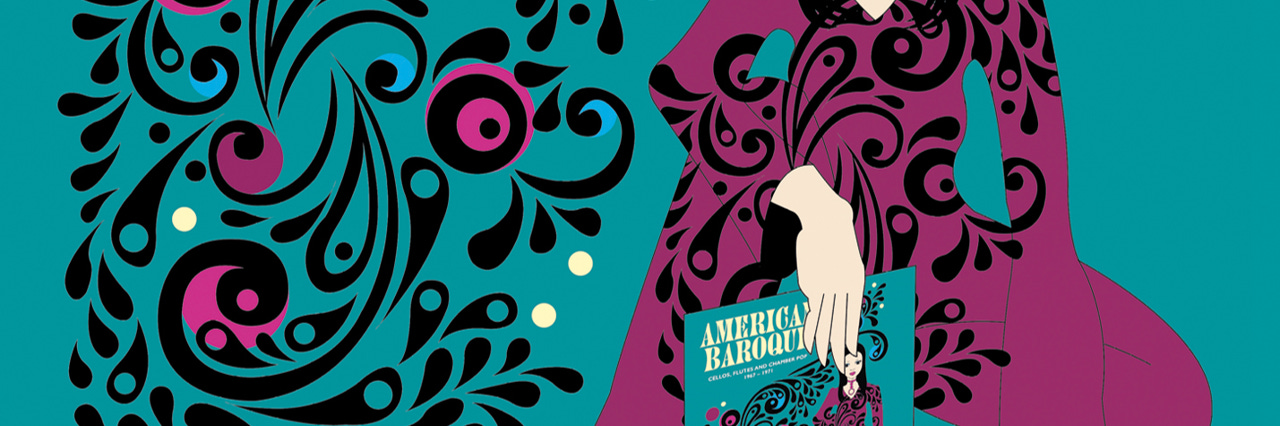
Thanks very much to Bob Stanley for taking the time. You can buy American Baroque here. Its totally gorgeous cover art, a sliver of which is featured above, is by the artist Lora Findlay.
*also MOTOWN