
bulletproof bishōnen
on the seven boy wonders of the world

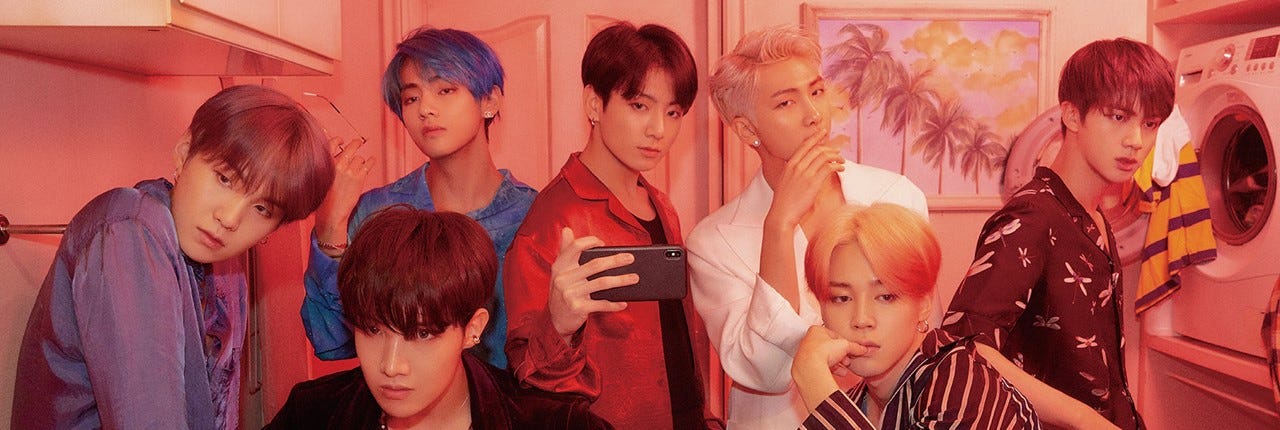
I’ve avoided writing about BTS for as long as I’ve admired them — the better part of a decade. I’ve heretofore seen this as a logical instinct. Just before their hiatus — which as you may know was necessitated by South Korea’s mandatory military service policy (shades of Elvis!) — they really did look like the biggest group in the world. They were the apex of the Korean wave’s third generation — a trailblazing instance of something other than the usual A-pop taking hold of the top slot (their dominance preceded Bad Bunny’s by a few years). Their impact has smashed statistics, and united swaths of the globe in a way Tay only wishes she could. They’re still simply an unparalleled cultural phenomenon, though it remains to be seen how hard they’ll hit now that they’re back.
Writing about all of this with any authority felt like it would require the discipline — the patient, studious research — of my favorite peers, whose foundational knowledge of global pop (or gosh, hip-hop!) and attention to current cultural trends is thorough, and whose appetite for the new is insatiable. If you’ve been to this Substack, you know that that’s not exactly how I roll. I tend personal if not diaristic; I’m stuck in the ‘70s; the demographic makeup of my subjects is shamefully white/male-oriented outside of my pop reports, though my efforts to correct this aren’t always so obvious. Moreover, I’m pretty public about my fear of talking out of my ass. So BTS feel like a subject best left for journalists and superfans — or at least writers like Dave Moore and Brad Luen.
But this is a fallacy. Yes, I’d love to be able to cite statistics or claim full consumption of BTS’ ocean of media (I’ve read Beyond the Story and seen some docs and shows, plus the music!). I’d love to be able to generalize about global pop trends like I have a grasp of them, or even speak with expertise to how pop and hip-hop have become mutually infused, and how K-pop’s evolution reflects these trends — to identify what you hear when you play these records, and connect unconnected dots. At the very least I ought to know what Seo Taiji and Boys sound like, shouldn’t I? It’s clear that pop in general continues to make innovative leaps, but the other night a very trusted source credibly opined that BTS represent sonic regression for K-pop. I had no more than an inkling.
Yet the point is this: I was there — as in, when the bomb hit. They reached me. I saw firsthand the effect they have on their ardent ARMY*, and became converted without hesitation to the sights and sounds they were selling. I’ve welled up at their mid-song climaxes, and felt deeper parts of me bloom in their sheer, sincere sunlight. I have my bias and my bias breaker and my permanent in-jokes (“I love countrySIDE!”), and not one of the seven members escapes my affection. Hell, I’ve fucked to Love Yourself: Tear more than once, albeit with the same person (and never again). And I’ve felt a unique loss, when our good seats for their Dallas stop on the Map of the Soul tour — our first BTS show — became our first personal signal that 2020 would be so weirdly horrible.
But what I always tell outsiders first — irreversible Beatle ho that I am — is that BTS let me see Beatlemania in the flesh. I’m well aware of the rockist Western box a Beatle comparison might represent, in a cynical purview. But they were what they were — an unprecedented pop explosion, to borrow George Melly’s term — because of an actual, measurable impact, rather than simply what they contained or allowed to be projected onto them. On a scale unthinkable before ‘64, they used music (plus wit, charm, looks and oceans of vision) to change everything: fashion, sexuality, sense of possibility. The only thing they didn’t shift was the Western hold, despite George’s efforts (in fact they likely intensified it). They weren’t empty hype; they were an odd, new kind of miracle.
The Beatle comparison is not meant as a box. It’s still a rarely-rivaled standard of just what a pop group can do. As such, the Fab Four’s built-in hyperbole is a useful tool of indicating just how runaway-gigantic the Magnificent Seven (nobody calls them that) have proven to be. The band has surely been aware of this standard, though a passion for hip-hop (and for a pair of them, dance), not pop, is what motivated their victorious participation in the sweepstakes. The trio of letters stands for “Bangtan Sonyeondan” — “Bulletproof Boy Scouts”, their first of many beautifully reconciled contradictions — but that it’s also Beatles sans three vowels and an L has to have made Bang Si-hyuk smirk. And on at least one occasion, the group indulged the comparison, in costume.
But that Ed Sullivan moment wasn’t their actual Ed Sullivan moment. It was — gauging it by the subjective but probably instructive aspect that my wife and I were not in any way seeking them out — their September 2018 appearance on Jimmy Fallon’s show. As the abnormally enticing, dark, skittery atmosphere conjured up by the gqom-inspired (I just looked that up) backing track filled countless rooms, seven gorgeous young men, in blazers ranging from “modern art” to “Vegas glitz”, stood in formation and started to jolt, sway, glide, interlock. A degree of gravity defiance was hypnotically evident, a choreography that was all craft and inspiration. “They call me artist”, went a fetching half-snarl, “they call me idol”, then slipped into an arresting torrent of mostly Korean.
It wasn’t exactly a cult providing that low hum of feverish white noise — a sound only the most rapturous fandom knows how to create. For the group had already hit #1 on Billboard with their prior EP, which the album they were hawking folded in with the preceding one. Their new product was even baited with one of a handful of we-didn’t-need-that later-era collabs with US pop artists, this one (on “IDOL”, the Fallon track) with, yikes, ex-hero Nicki Minaj. So they clearly weren’t secrets, especially given that America is not the Only Place on Earth. But as I and surely many others have written before, there is something to be said for the moment that you first feel a cultureshock, something about the shock as well as you. There’s big, and there’s planet-swallowing.
Truth is, that was the moment that got me — but not the night. I was away, as was my wont, grinding my axe by dealing some new indirect blow to my wife’s kicked-around heart. Regular readers have pieced together that she and I, who were in love since we were teens, did not have a happy time, and I’ve tried to make clear without graphically self-indicting that I shoulder that blame, at least most of it. One of the most complex, brilliant people I’ve ever known (best believe her article about the same subject would be seven times better than this), I won’t embarrass her or risk injustice with an in-vain sketch. Yet how severe her anxiety was, and how deep her traumatic depression ran, is so important to set the scene this captivating group was to finally pull my girl beyond.
My part in this story matters less. But the point is that some souls have been pushed so far back into their host’s darkest depths, and some lips sewn shut with fear. So just try to picture a person who always glowed so naturally, and with the rarest vivacity, in the broken thick of their darkest hour. If you’re doing it right, your heart already hurts — and that, that is my part. Now — envision a unique miracle. In a bold, dizzying, heart-swelling burst of color and sound, seven positively angelic, diversely charismatic boys, unlike anything you’ve ever witnessed with eyes or ears, reach into those depths, and in a profound dazed instant pull that sweet soul back to the surface. We all know that pop can do this. It’s why we’ve made its practitioners into idols, and why that’s not so wicked after all. Those boys would lift my wife through her slow and painful rebuild.
Yes, her ecstasy had a girlish quality. But not naïve — elemental. After all, so much of her healing was about reclaiming the emotions and sensations of the youth I’d stolen. But even if BTS weren’t bound to raise those spirits from ground level, some form of transcendence is the guarantee in pop like this, in forces like the Beatles or BTS or all the others in between. My wife fell in love with these boys, if to different degrees and for different reasons; their existence was her excitement, plus all the ways to immerse herself in them (variety shows, and livestreams, and online diaries, and movie-theatre concerts, and so many gorgeous editions of so many CDs with so many heartstopping photos inside). They became a reason for living; they threw light back into her world.
If K-pop fandom, or any fandom that has people shrieking and clutching tear-streaked faces and hair shaking to the beat, to say nothing of filling up stadiums or goosing the sales figures or applying this almost absurdly sturdy sense of community to the hugest righteous causes (remember what we owe ARMY for fucking with our president in ‘20, back when we thought maybe we could buck him) — if any of that stuff feels bizarrely parasocial to you, well, take out the bizarrely, asshole. The love and joy idols inspire in their fans is beautiful. When a pop star is such a potent force, a force of love and hope and empowerment by design — and that this is seven pop stars, the bond as deep and unbreakable as the Beatles’, is so key, insofar as these groups are models of harmony and progressive cooperation — they can literally save you. This is the miracle of BTS.
In case this is information you still require, the seven members of BTS are as follows. Other than #1 (K-pop groups appoint captains), the rank is in descending order of age.
Kim Namjoon (RM) — their leader, and as a rising talent on the Seoul rap scene at the time of the group’s inception, its catalyst. Exceptionally charming, amazingly erudite, clearly someone in perpetual deep thought (but not in a heavy way, not at all), with his near-perfect, distinctively poetic English (learned from Friends!), he’s an apt choice for group spokesperson. While by now he’s matched for ambition by many of his cohorts, that was a big gap to close. The group’s whole rap line is brilliant, but with his breathy voice, canny flow, and neverending cleverness, I think RM rivals some of his idols. I’ll give him the benefit of the doubt that his Drake worship (the idea of a singing rapper blew his mind, and Take Care appealed to his tortured romantic side) has abated a bit.
Kim Seokjin (Jin) — Mr. “Worldwide Handsome”, Jin is certainly cute, in a slightly less androgynous way than his fellows. There isn’t a hint of darkness on this man’s surface. Interested in acting, and not naturally gifted musically (he’s a solid, generic singer), he was spotted the way an actor or model would be — face first — and it’s in Jin’s nature to be cheerfully along for the ride. For a group that is not even a little bit ironic (which I believe is the closest they come to a real drawback), Jin is their best source of humor — every kernel of chipper corn gets a tart twist from his bright, surreal deadpan. The best example of this is his solo lark “Super Tuna”, a bite-sized trot homage, and work of minor genius. He is the likeliest to pursue a quiet, normal life when the ride is over.
Min Yoongi (Suga) — while Big Hit founder Bang, a successful writer and producer, at first divided the lion’s share of this work between himself and the team of Pdogg, Slow Rabbit and Supreme Boi, Suga has been involved in BTS’ actual music from the start. In fact, no other member’s passion (or gift) for music itself quite equals his. While his stone face is unmatched — his dark and serious air sets him apart from the others —Suga’s flow is intense and exciting, with a sort of unhinged quality, and a fascination with consonance texture. Whereas RM is their front-facing genius, Yoongi is like the stoic master behind the scenes. He has accordingly branched out into a lucrative side hustle as a producer; he’ll surely do standout solo work till he drops dead at his desk.
Jung Hoseok (J-Hope) — J-Hope holds enough exuberant positivity for seven separate humans, and somehow he hasn’t exploded from it — though sometimes he will emit a hyperactive noise like he’s ventilating it. My bias, and that is not a musical judgment (when I was learning these boys, it was his face and energy I first felt most drawn to), J-Hope is the ideal way to complete a rap line trio with two geniuses who tend somber. While he’s explored darker depths during the hiatus (when Hobi goes dark, the world feels off its axis), he’s all about the joy of it, with enough electric enthusiasm to power South Korea. Still, his flow is complex, and with its gleeful impudence and aggressive nasality it’s closest to Eminem. He’s also, at his best, the greatest dancer ever to do it.
Park Jimin (Jimin) — unless, that is, Jimin rises to his challenge. (He and J-Hope were closest to each other coming up, and their boundless passion and talent for dance was their greatest glue). While outwardly, Jimin matches J-Hope’s sunny disposition, there is a bristling sensitivity beneath it, a deep core wound that mostly manifests in bitter gusts of melancholy. To this end, in his most stirring dance work, Jimin conjures the profound emotions you’d find in the greatest ballet. His timbre is quite high — shades of Michael — and his face the most cherubic. As BTS cast off performative “bad boy” BS and began to blur gender lines a bit, Jimin is who really drove that element home. And while it’s rude to bet if any of them are gay, if you’re gonna put a lot in the pool…
Kim Taehyung (V) — “hello, my alien,” as Jimin once sang to the member he used to butt heads with the most. With his husky voice and unnerving mix of blank face and pointed gaze, V is in some ways the group’s oddest man out, a role he embraces with relish the more their level of success necessitates self-definition. V is that self-styled sophisticate friend whose fondness for anachronistic aesthetic leads to choices that are both classy and a little eyebrow-raising. But since none of these boys ever miss a style step, V could absolutely be the straight-edge Chet Baker if he learns to play the trumpet. BTS’ vocal line once had to strain to avoid superfluousness, but by now, V seems quite comfortable in his contrast — after all, none of the others sound as sexy.
Jeon Jungkook (Jung Kook) — our Golden Maknae (“maknae” is what you call a group’s youngest member) was once capable of a puppy-like guilelessness that, with his level of natural adorableness, could stop your heart. (Kookie is, yes, my bias breaker). Yet he earned his designation. Even from the start, he was the “other member” most capable of pulling up alongside the three leads in a metaphorical drag race. A fine rapper, an incredibly fine singer, a dancer who holds his own with the other Js (no no, not Jin), and a beam of pure beauty whose target knows no gender, this kid is upsettingly talented. Moreover, he’s immensely likable. What sets him apart from RM and Suga is a natural intellectualism built into both. But give him a few years; you are not to count him out.
When the septet was assembled, “hip” and “innovative” did not seem to be ingredients in the flavor Bang was seeking. RM and Suga were honestly passionate about hip-hop, and had a strong, varied interest in their own country’s pop musical history — in their first recorded skit, the group goes off fondly recalling Epik High’s “Fly”. As proven in the years since, the talent was all there. Yet the distance between Big Hit’s clout, savvy and resource and that of the industry’s “big three” labels — SM (Girls’ Generation, f(x), Red Velvet, EXO, Shinee), YG (2NE1, Big Bang, Psy, Blackpink), and JYP (Twice, Stray Kids, Wonder Girls) — was sizable then, and it served, in a sense, the “hook” the team finally found for the group. What the boys would come to represent was a persistence narrative they’ve since cultivated into a wondrous worldwide self-acceptance program.
Obviously, like all growth and well-met challenges, this required rigorous honesty, as well as (P)dogged determination. But in the initial rollout, they seemed to be courting mockery, hungry for the title of frontingest hip-hop act in the genre’s history. Regarde:
The titles of their first records, from ‘13 and ‘14, don’t exactly lift your face out of your palm: 2 Kool 4 Skool, O!RUL8,2? and Skool Luv Affair (the latter has a Special Addition as well). Yet the music isn’t nearly as unconvincing, though the debut release feels a little unnecessary (three real songs, lame interludes). It is, however, unashamedly derivative. Already, they’re honing messages directed at disillusioned young folks coming of age; already, they’re flirting with pop and even a bit of R&B balladry. At its best the sound is spry, bassy, and good between headphones, and clearly the product of a sincere hip-hop love. But it was a framework that would alter significantly the more the members would be allowed, little by little, to fill it with their individual sensibilities and tastes.
It’s conventional wisdom that charges of inhumanity are not totally unfounded in the world of idol manufacture. Hours and demands are grueling; sleep is stolen; the whole process essentially unfolds in isolation. Every ounce of energy is given to the project, and while no K-pop group spares you a show, not all of them throw themselves into it with quite the effort and gusto (and seamless grace) as BTS. The process has tragically driven a number of these stars to suicide. And while those dark odds seem conquered now that BTS’ success is minted, it’s useful to remember that beneath all this silliness, which their future peers were unsparing about, these boys were breaking their backs; that’s just how it works. It’s a proving ground most of us surely wouldn’t vacate intact.
For their first four releases, BTS would lurch forward and get blown back at reliably alternating intervals. Yet they track a linear growth, as each member settles into his role (though it’d be a hot minute before Jin, Jimin, or V would emerge into their own), and the production team finds the fun and nuance in their style-blending settings. At the end of this sequence came their first full-length album, Dark & Wild, which at its best is a total trip — RM is just a fantastic rapper, while Pdogg was popwise from the start, and the whole thing is an admirable culmination of the hyped-up energy they at first donned like fashion victims. Luen reckons it their peak, and Brad is one of those critics who can get me to question everything (not that he’d ever intend this, mind you).
Yet for me — and for a pretty sizable share of fans — Dark & Wild is where the group last leads with a vibe they were bound to cast off, to their immeasurable benefit. BTS were clearly doing something right by ‘14, and let’s never underestimate how much of what was working came horizontally rather than top down; like the Beatles, sharing a singular pressure cooker forged bonds between these seven people utterly unlike any other kind. Their triumphant appearance at that year’s MAMA Awards represented a riveting seizure of a narrative they’d ridden as smoothly as one’s first buckin’ bronco. That said, some of Dark & Wild’s criticism included charges of misogyny — and while intentions were surely good, it was a logical outgrowth of the way BTS had come on.
The shift signaled by their Most Beautiful Moment in Life series would be, above all else, a softening, reflected in their leader’s more or less concurrent switch of his acronym’s expansion from “Rap Monster” to “Real Me”. The unabated angst, the rascally lust, the empty threats, the bullet sound effects; all would be rolled back in favor of an airy and exploratory pop production style that’s always smooth and rarely experimental, yet in the same breath feels new under the sun every time out. That is the nature of modern pop, after all: fresh syntheses with each hit. The spacious, aching “I Need U” heralded this change. It makes perfect sense — the flipside of the old stance was vulnerability. Doubt would be validated, not fought down. Lovers would be wooed, and genderless.
Big Hit made innovative use of direct communication between the band and the fans, and recall the kind of trembling open heart of the most devoted sort of fan, as I tried to paint it for you at the start here. BTS were skyrocketing, to unreachable heights. Yet their new commitment was not to projecting a standard to aspire to. It was more like a sweet equalization. They would not leave their fans feeling like they could never get where they got, even if the fans already accept this. They were now proselytizing for the value everyone has, and don’t fool yourself that self-acceptance isn’t radical. This inversion of idolization — not “look up to us” but “we are behind you” — isn’t brand new. But on the scale that they’ve since spread the message, it’s pretty revolutionary.
In an unbroken line, from Most Beautiful Moment to the Love Yourself cycle they went on Fallon to celebrate, so many wonderful singles and thousands upon thousands of new fans continued to pile up. (Across this period, each rapper issued a creditable solo mixtape — Suga’s monochromatic Agust D, J-Hope’s mercurial Hope World, and RM’s ethereally downbeat mono.) Between those two rollouts came their first stab at a piece of self-conscious Great Art: Wings, for which the team put together a highly dramatic accompanying storyline, which they then turned into highly dramatic short films. As deliberate White Elephant pop goes, Wings is richly emotional, its landscape rife with gripping peaks. RM had been reading Herman Hesse’s Demian; it figured in somehow.
Wings is also the first time the vocal line were granted features, opportunities to flesh out still-nascent personas. (Every time someone gets a “solo” spot, they’re encouraged to bring something material to the table, even if it’s just humming a melody or tossing out a concept.) All seven members had their own space on Wings, and these were only not the best songs because the surrounding material was continuing to strengthen. A serene reflection on his unimaginable progress, Jung Kook’s “Begin” is mesmerizing; Jimin’s surging, yearning “Lie” is one of the best BTS songs those who’ve dodged the ARMY don’t know. After casually murdering his first “Intro” feature, J-Hope finds a sound to match his breezy whimsy on “MAMA”. V’s “Stigma” flirts gently with jazz.
Their records from ‘15 to ‘18 teem with classics. “Dope”, “Silver Spoon”, “Burning Up (Fire)”, and “BTS Cypher Pt. 4” show how the band never lost their bite — they’re just finessing its context. When they cool off and lean all the way into sincerity, as on the beloved “Spring Day”, they’re just as relentless; the dew from that song’s dawn-kissed new grass finds its way into your eyes every time. BTS’ releases now felt like, to steal a title, “Magic Shop”s, and the day-night companion pieces Her and Tear kicked it all up another notch: “DNA”, “Dimple”, “Best of Me”, “Pied Piper”, sundazed “Serendipity”, sultry “Singularity”, wiggy “Go Go”, dancefloor-melting “Mic Drop”, shattering “Fake Love” (“I’m so sick of this” and “I’m so sorry about this” in one midnight-hued hook), groovy “Airplane Pt. 2”, alluring “Anpanman”. On Answer, each rapper came up with his own coup: itchy “Just Dance”, broken “Seesaw”, and note-perfect valentine “Love”.
The bugs in the system were long gone. Their audience was captive and massive, their victories were unconfined by borders, and their competition, at least at this beautiful moment, stood in their shadow. They’d reached that special spot of an imperial phase where you get to reflect and stretch out some. And because their success loosened (a little) their company’s iron grip, and their sound embraced pop, there was no need for a Stevie/Marvin-style battle. We were restlessly eager to witness the next step forward.
A seed of this next step was planted way back in the fever-dream video for Wings’ lead single, the moombahton-inspired (I just looked that up) “Blood Sweat & Tears”, one of their best-ever hits. Cavorting, dapper as fuck, at some psychedelic mad tea party, the disorienting clip did a lot to fuel my gradual opening up to the group. (For no: I wasn’t instantly aware they were as great as they were). I embedded it earlier, not just to sell you, but to spare myself the task of describing it. Yet in its bananas coda, after an RM voiceover whose every syllable tickles me, a striking new element rears its head. As Jin stands struck by something in an empty room, with dark mischief, V sneaks up behind him and covers his eyes. The parted hands reveal a bald, breastless, and black-winged statue. Jin slowly approaches it, draws a hand down its cheek, and kisses it on the lips.
Let’s not play around here. To this very day, and I live in Texas, any hint of queerness is liable to perk up the hateful antennae of the world’s worst people. The message of that moment, while hardly innocuous, seems to be more like a “satanic pact” thing. But it underlined an awareness of their relative androgyny, and maybe, just maybe, curiosity over its potential uses. My best guess is that most of the BTS members like girls. Yet the divine feminine is alive and radiant in more than just Jimin. As the boys’ politics are uniformly, expressly progressive (if in an open-armed, apparently apolitical way), and they’d already won platforms at places like the freaking UN, the blast of bright-pink queer utopia in a new 2019 video was a thrillingly predictable pleasant surprise.
“모든 게 궁금해 — how's your day?” coos Jimin at the opening of “Boy with Luv”; he’s never been femmer, giddy with unconcealed twitterpation, a kind of sweet submission it would’ve been antithetical to depict five years before, for the far more aggro “Boy in Luv”. “Oh tell me,” he sighs, “oh yeah, oh yeah” — and then repeats, with the subtlest degree of feminization, “ah yeah, ah yeah”. He’s leading their usual airborne-interlock configuration, and you note that the wardrobe this time out is rose-colored PJs. Look at him move throughout this entire beginning. Every glance, every little gesture, is the unmistakable rapture of a boy whose inner girl, the one who relaxes his entire being and slides him suavely into himself — herself — is awake and aglow. This is my drug.
“Boy with Luv” is not just my favorite BTS song. It is a candidate for my favorite song ever, and when it’s on, it nestles swiftly into that position. Its video has no challengers. Every moment enflames a light inside me to the point where I cannot help but tear up — the blissful segue from Suga’s lip-biting, piano-stepping verse to J-Hope’s jubilant dance out the door, or Kookie throwing his arms up to announce his favorite hyoung’s climactic verse, or the simple genius of the finest chorus about being in love I’ve ever heard: “oh ma-ma-my, oh ma-ma-my,” a cupid’s arrow aimed a lot truer than “de do do do, de da da da”, driven home visually by stellar supporting player Halsey coquettishly raising her hands to her lips. They’re doing it, I thought. They’ll turn us all into girls.
An unusual pet fantasy to be sure. Yet look at everything around us and you know how much better off we’d be. Whatever you’d call this a burst of — it mattered, I think, that this was not a piece of queer media, yet in so many overt ways resembled one — it felt like the revolution was being, if not “televised”, streamed by dazzling record numbers within hours of its first shot, a shot quite literally heard around the world. Here in 2026, it’s hard to see what “Boy with Luv” really affected. Yet it still resonates, so vibrantly. Looking back, their open flirtation with this fluidity feels like their bravest act of all.
The source — mini-album Persona, itself proudly pink — sported a more diverse, if no less satisfying, sextet of new wins. RM’s swaggering “Persona” and the barn-burning “Dionysus” (with one of the best J-Hope moments of all) provided fiery bookends. In between, “Make it Right” set a new standard for delicacy and empathy in an I-fucked-up hit, and “Mikrokosmos” sounded like nothing more than getting blithely blinded by sunlight dancing across the water. The repeating seventh chords and melismatic title hook in “Home” showed off their new, easy mastery, while the elegiac, faintly desolate “Jamais Vu” slipped a secret knife in your heart and sat contemplatively as the blood ran down. They had a soundtrack for every emotion. And in ‘19, we were feeling a lot.
Follow-up releases entitled Shadow and Ego — RM had been reading Jung this time — were scrapped in favor of a full-length which, like Young Forever and Answer, absorbed the Persona tracks (though it cut “Mikrokosmos” and “Home”, for no good reason, in favor of a pointless Sia duet version of the lead single “On”). No matter — in this way we got the ultimate BTS album, Map of the Soul: 7. The record was by turns bright and bleak, playful and pensive, haunted and horny, sweet and savage. The atmosphere and melodic beauty were at peak levels, yet the pop contours were sharp as a princess cut. I have my favorites — “Louder Than Bombs”, the irresistible RM-Suga duet “Respect”, Jimin’s breathlessly sweaty “Filter”, Jin’s ebullient “Moon” — but everything connects. The penultimate “We Are Bulletproof: Eternal” is the ultimate love letter to a fandom.
If anything was to signal their Beatles at Pepper heights moment, I thought 7 would be it. Being a BTS fan felt so good going into 2020, and I wasn’t just excited to finally see them live — I was even more excited to see the kinds of happiness being that close to them would bring out in my long-suffering wife. If I get into the weeds about the not-entirely-cosmic unfairness of the subsequent disrupting event we’ll be here all day and the tone will shift irrevocably to fatalism. But suffice it to say that BTS’ imperial phase was bound for an early interruption. Ahh, but that’s pop — the zeitgeist likes to shake things up. They dealt with it as best they could. The rather tranquil Be was a tonic for hard times, and while the cynicism over HYBE (née Big Hit)’s big idea for a conscious consolidation of their primacy, the sprightly English-language trifles “Dynamite” and “Butter” (needn’t mention the other one), was half-merited, they’re first-rate radio pop.
They’d long been due for a break. This piece has skipped like a stone over a couple of key moments they doubted they could go any further. But this was, in a backward way, the way to land. The band had too much uprightness and patriotism between them — both a symptom of integrity — to want more stays for the mandatory military service, and honestly, what hadn’t they accomplished? In any case, it was unbelievably beyond anything they could’ve imagined when they first assembled, even years in, when they were still searching for a better-tailored approach. And after all, even if one loves the strange family that forms in a pressure cooker like the Korean pop industry, any such closeness will someday yield the thirst for space, for a big change, for your own thing.
So the seven artists/idols (& I) went solo over the last few years — for a hiatus, they’ve been awfully productive. RM released his best, most adventurous music, as if scraping those last singles out of his system. Least-likely-to Jin took his time and came up with a laudable rock album, though that voice will always be a little too whistle-clean. Suga continued to find productive outlets for his love for hip-hop as Agust D — the real rap monster in BTS. I can more easily appreciate, years on, the daring and stormy Jack in the Box by my bias, who I’m still proud of for Hobipalooza. (Don’t sleep on this cover, either.) Jimin made bank with a pair of EPs, sashaying further into self-actualization; his greater burden of proof elevates each. V elegantly sedated us with his own record, only to perk up our ears with infrequent feats. Jung Kook just threw a sleek star party.
Their absence left room to mull the ways their reign diverged from those English lads to whom I compared them at the top. Even as the self-evident Biggest Thing, the band never quite felt inextricable from the air around us. Sure, I could sharpen my point by capitalizing “us”; it was probably a lot easier to catch them with every inhale in South Korea. But while the fact that they’re far from inescapable says a few things about pop in 2026 vs. 1966, as a devotee I’m irked, the way I still get irked remembering those US-originated zephyrs of disrespect. Nobody over here knew exactly what to do with BTS, once they’d won our gold and proven here to stay. The scene they ruled in 2020 looks razed and rebuilt. Of course, if their great contribution is shattering the perception of their nation’s pop as pure novelty, and paving the way for a more enthusiastic embrace of the maybe-even-superior groups working now — NewJeans, NMIXX, HYBE’S own KATSEYE, coincidentally (cough) all girls — it’s an achievement on their music’s level.
Of course, today we have cause for euphoria — a new album, ARIRANG. And because it’s today, this piece cannot account for how it’ll land, though we all expect it’ll top the charts. What it can account for is its first impression on this writer — who’s riveted by its energy and the breadth of its sonic palette, who’s admittedly a little thrown by the presence of name-bro producers from this hemisphere (Ryan Tedder, Mike Will Made-It), who’s certain he’ll need time to turn it all over, and who’s excited to have BTS back. Intriguingly, it’s a hard retreat from the abundant melodicism of 7, accompanied by an influx of vicious intensity. In brief, it’s dark and wild — and the most boy they’ve come on in a while. But it’s more likely to broaden than befuddle their long-starving ARMY.
Either way, pop is more than our escape now; it’s one of our surefirest weapons, under fire from all sides. BTS tried — and so much more effectively than anybody could have predicted — to unite and uplift us all with love, just like that old quartet. Yet 2026 has seen hate heat up with terrifying alacrity, and many of us on the good side feel readier than ever to roll our sleeves up and join the fight. Now, the boys are back in our army. We don’t need permission to dance through dark times. But as long as this great band resumes its noble mission of reminding us of our right to, of compelling us to our feet, we’ll still be better off than we were when they were gone. It’s all up in the air. Except for one thing: my old flame has her tickets for their next visit. For now, that’s enough.
*Adorable Representative MC for Youth(!)
Loved reading this heartfelt take on BTS! 💜 You beautifully captured their emotional resonance and personal impact... I felt your connection, especially im how they offered self-acceptance... As a Beatles fan, I totally got your personal journey, though I’d love to learn more about them and their clearly broader cultural footprint. It’s a rich, layered piece... Maybe requires a second read when I have a bit of time! 🫶